What Pool Safety Features Should Tampa Bay Homeowners Plan?
Plan pool safety while the layout is still on paper. Florida law requires a new residential pool to meet at least one listed safety-feature option before it passes final inspection[1]. Options include a barrier, an approved safety cover, an access alarm, a self-closing door device, or a certified pool alarm[1]. Confirm code details with the local permit authority[3].
A good plan answers more than “What can we install?” It maps who can reach the water, how barriers and gates work during an ordinary day, and what habits continue after construction[3][4]. These decisions are easier to coordinate while the pool, deck, doors, and yard are still being designed[3].
What safety features does Florida law list?
Florida Statutes §515.27 names five safety-feature options for a residential pool to pass final inspection:
- An enclosure that isolates the pool from access to the home and meets Florida’s pool-barrier requirements[1].
- An approved safety pool cover[1].
- Exit alarms on all doors and windows that provide direct access from the home to the pool[1].
- A self-closing, self-latching device on all doors that provide direct access[1].
- A swimming-pool alarm that detects accidental or unauthorized entry into the water and is independently certified to ASTM F2208[1].
The statute treats these as options, but it does not tell you which configuration is right for a particular property[1]. Nor does a short list replace plan review[3]. The Florida Building Code includes standards for residential pool barriers, covers, latches, door and window alarms, and related equipment[3]. Responsibility for code enforcement and interpretation sits with a specified local board or agency, and local governments may adopt more stringent technical amendments within their jurisdictions[3].
For a Tampa Bay project, confirm which building office has authority over the address and ask what it requires on the plans[3]. Do that before treating a drawing, product label, or verbal answer as permit approval[3]. This article is general planning information, not a permit determination for a specific parcel.
Why plan the barrier before the deck?
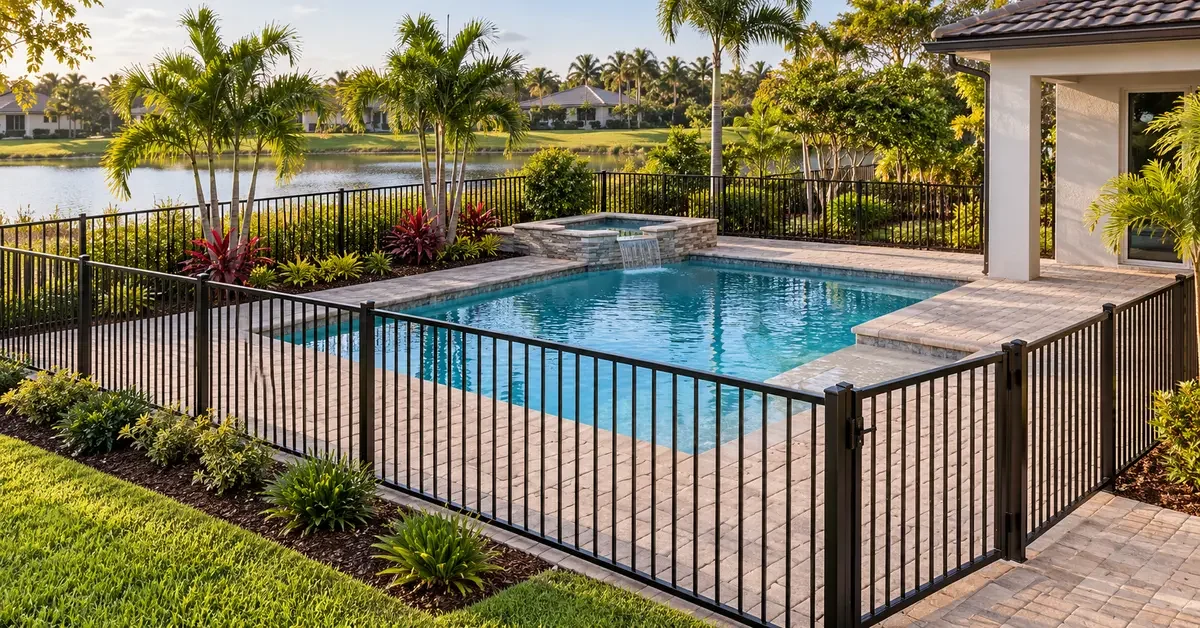
If a barrier is the selected feature, Florida law sets details beyond simply having a fence[2]. The barrier must be at least four feet high on the outside, limit openings and footholds a young child could use to get through or climb over, and run around the pool perimeter[2]. A yard fence can count only when the portion used as the pool barrier sits on the pool perimeter and meets the statutory requirements[2]. The barrier also has to be far enough from the water’s edge to reduce the chance that someone who gets through it immediately falls into the pool[2].
Gates are part of that plan, not an afterthought[2]. Florida law says gates that provide pool access must open away from the pool, close by themselves, and have a self-latching locking device with its release on the pool side, placed so a young child cannot reach it over the top or through a gap[2]. The law also prohibits placing permanent structures or equipment where they could be used to climb the barrier[2].
Ask the designer to show the complete barrier line, each gate and its swing, direct routes from the house, and nearby fixed structures on one plan[2][3]. Think through how people will use the doors and patio in real life[3]. A beautiful deck layout is not complete if it leaves the barrier or gate route unclear[2][3].
The CDC recommends a four-sided fence that fully encloses the pool. Planning that boundary as part of the backyard layout gives you a concrete question to take to your designer and local building office: where is the controlled line between the yard and the water?[4]
Where should doors, gates, and alarms fit?
Start by identifying every opening that leads from the home to the pool[1]. Under Florida’s exit-alarm option, the requirement covers all doors and windows providing direct access; the self-closing, self-latching option covers all direct-access doors[1]. Mark each opening on the plan, then ask how the selected feature and any barrier will work together[1][3].
Keep the two types of alarms straight[1]. The statute describes exit alarms for doors and windows separately from an in-pool alarm[1]. The in-pool alarm option has its own detection and independent-certification conditions; the law specifically excludes personal alarms attached to an individual[1]. If an alarm is being considered, identify the exact product and ask the permit authority how it fits the project’s requirements[1][3].
A gate that is routinely propped open is not functioning as intended[2]. During design, consider where people will enter, where a gate can swing without being blocked, and how a latch can remain usable while still meeting the applicable requirements[2][3]. These are practical layout questions, not details to leave until the deck and access paths are fixed[2][3].
Are a cover or alarm the whole safety plan?
Florida’s statute includes an approved safety pool cover and a qualifying pool alarm among the listed options[1]. If you are considering either, confirm the exact product and installation requirements with the pool professional and the local authority[1][3]. Do not assume that any cover or alarm satisfies the statutory description just because it is sold for pool use[1].
A required feature is one part of a safe routine, not a substitute for supervision[1][4]. The CDC recommends designating a responsible adult to supervise closely and constantly when children are in or near water[4]. Build that routine into how the household will use the space, including who watches, how access is controlled after swim time, and how visitors will be told about the rules[4].
What should you ask your pool designer before approving the layout?
Use these questions while the drawing can still change:
- Which §515.27 feature or features are shown in the plan, and what will the final inspection look for?[1]
- Which local building office reviews this address, and has it confirmed the applicable code and permit details?[3]
- Where does the barrier run, which gates provide access, and how do doors and windows connect to the pool area?[1][2]
- Are any fixed structures or equipment close enough to affect the barrier design?[2]
- If the plan uses a cover or alarm, what exact product is proposed and who confirms that it meets the applicable requirements?[1][3]
- How will the household keep access controlled and assign close adult supervision when children are near water?[4]
The right time to answer these questions is during design, while the pool, deck, and access route can be considered together. From The Ground Up Pools serves homeowners in St. Petersburg, Tampa, and Clearwater. Explore our pool design services and pool installation services, then contact the team to discuss your property and the questions you want resolved before construction.
Frequently asked questions
Does Florida require a pool fence for every new residential pool?
Florida law lists a compliant enclosure as one of several safety-feature options for final inspection[1]. The same section also lists a safety cover, alarms on direct-access doors and windows, a self-closing door device, or a qualifying in-pool alarm[1]. Confirm how the code applies to your plans with the local building office[3].
How tall must a Florida pool barrier be?
When a barrier is used, Florida law says it must be at least four feet high on the outside and meet additional requirements for openings, placement, gates, and climbable structures[2]. Height alone does not establish that a barrier complies[2].
Can a pool alarm replace adult supervision?
A qualifying pool alarm appears on Florida’s list of safety-feature options[1]. The CDC still recommends close, constant supervision by a designated adult when children are in or near water[4]. Plan for both the required feature and the daily supervision routine[1][4].